
August 24. 10 km, 20 feet of climbing. Camped at 6,514 feet.
We spent the morning still.
The wind had blown steadily through the night, straight out of the north, not especially cold by the numbers but sharp enough to feel punitive once the sun dropped. Up here, even moderate wind takes on weight. The tents held well, but there was no urgency to move. So we waited. Drank hot drinks. Dozed. Watched spindrift slide low across the icecap and tried not to read too much into the weather.
By late morning the edge came off it. Not calm, exactly, but workable. We decided on a half day.
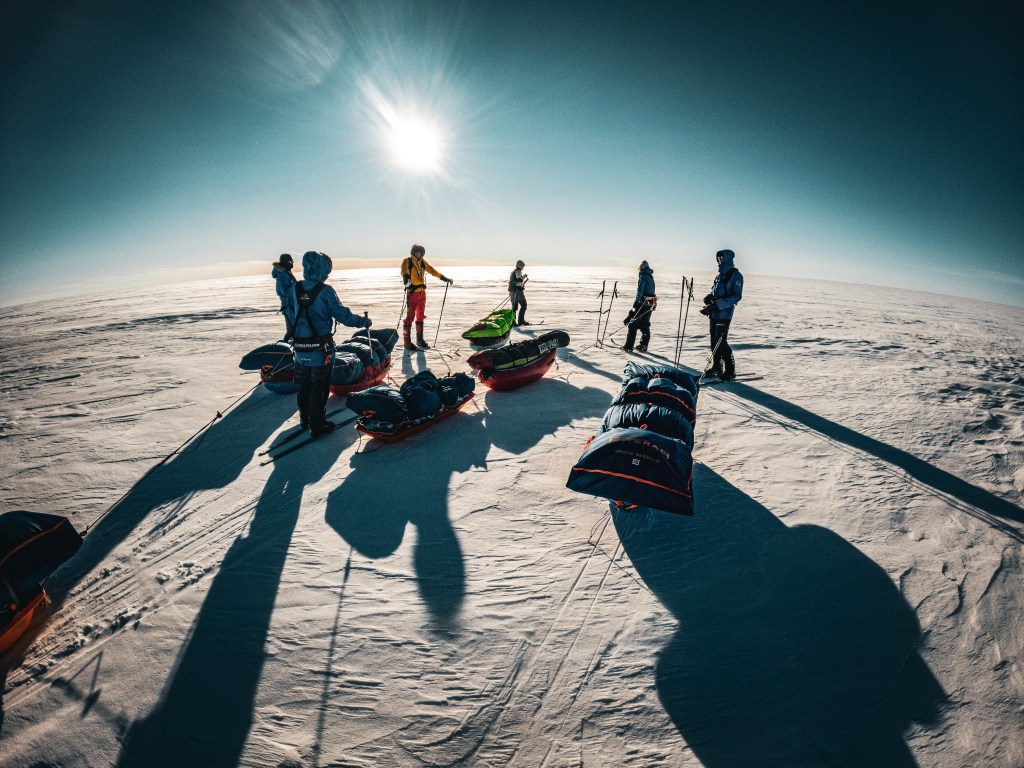
Delayed starts carry their own friction. Systems that usually flow get compressed. Small decisions stack up. Elaine felt it in the rush to get moving, leaving her harness buried in a fully packed sled. Frustrating, but not catastrophic. Out here, irritation has to be dealt with quickly or it grows heavier than it deserves.
Once we were moving, the skiing itself was uneventful. Ten quiet kilometers. Almost no climbing. A subtle but meaningful directional shift put us on a bearing of 281 degrees, aiming west toward DYE-2, the only human-made landmark we’ll encounter on the entire crossing. It’s a strange thing to navigate toward something you can’t see, can’t feel, and won’t reach for a very long time. Just a point on a map and a concept in your head.
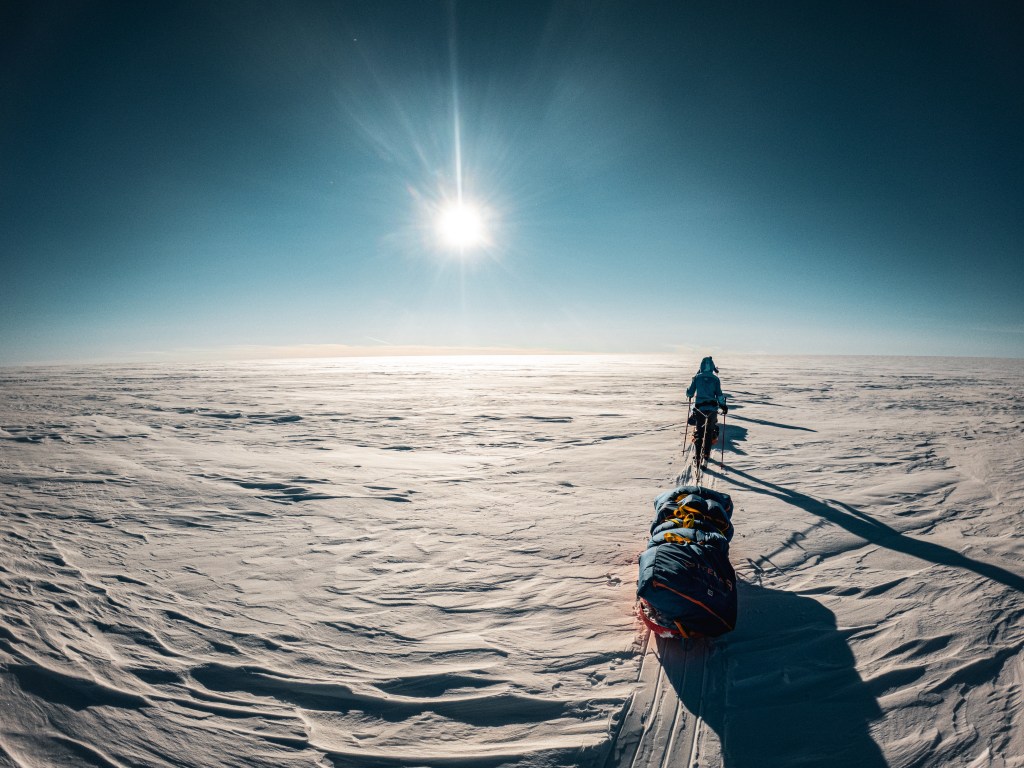
The landscape offered nothing new. No features. No life. Just ice and snow folding into itself in every direction. It’s hard to describe how complete the emptiness is. Not dramatic emptiness, not storm-driven or menacing. Just total absence. Humans are not meant to be here. Without our sleds and the small collection of systems we drag behind us, survival would be measured in hours, not days.
That realization sits oddly alongside the act of choosing to be here.

I keep thinking back to our first trip, standing in Tasiilaq, telling a local Greenlander that we planned to cross the icecap. He looked at us, genuinely confused, and said, “Why? There is nothing out there.” To people who live in this landscape, who hunt and fish and work to survive, the icecap has no purpose. It offers nothing. Going up there simply to go feels unnecessary at best, indulgent at worst.
It’s hard not to interrogate that. There’s an uncomfortable privilege embedded in this kind of travel, a sense of doing something difficult largely because we can. I don’t think I’m here just to check a box, but the quiet and repetition leave plenty of room to question the why of it all. Out here, with no distraction, those questions don’t stay abstract for long.
In some ways the day reflected that mood. Sparse. In-between. More waiting than moving. The wind made navigation easier once we were skiing, steady and honest, but it also reinforced how small our progress really was. We are well into the crossing now, far from the beginning and further from the end, with a long, invisible distance still ahead.

By evening we were camped again, tents settled into the snow, routines resumed. The wind lingered but behaved. There was no drama, no reward, no sense of accomplishment beyond the quiet fact that we moved when it made sense to move, and stayed put when it didn’t.
Some days are about momentum. Some days are about restraint. And some days, like today, are about sitting in the middle of the map and accepting how empty it really is.


 Alta Backcountry
Leave a comment